
What Harvard’s White Walls Taught Me About EdTech, Space, and Pedagogy
From Writable Walls to Whiteboards: Lessons from Harvard on what happens when operational decisions override pedagogical intent.

R.I.P. the White Walls in Longfellow
I returned to Longfellow Hall 319–320 after Spring Break in 2022, and an “innovation” shocked me to my core.
As a student who’d studied in that room the year before, I had always loved the classroom. It was a floor-to-ceiling, prize-winning space where students could walk right up to the wall and start scribbling. Any pedagogist or Montessorian would tell you a hundred reasons why that’s such a fantastic idea. The thought that went into the design was evident to every professor who taught there. I would’ve gladly traded any other Teaching Fellow just to teach the 9AM section because of what the space made possible.
And most students at HGSE knew. That room was always in high demand because it offered something rare: the freedom to think out loud, to sketch, to connect ideas, to move. It was designed for learning, not just instruction.
In the Spring of 2023, I was serving as a teaching fellow for Dr. Hadas Eidelman’s popular statistics course, S030. We loved that classroom. The pedagogy we had in mind: asking students to map out their charts, draw regressions, build conceptual models: relied on the 360-degree writable walls. You could draw an arrow, pause, reflect, shift perspective. The room itself became part of the conversation.
But when we came back from break, we found a “remarkable improvement.” The walls had been painted over. Green paint. Fixed, framed whiteboards hung here and there. Small. Confined. And with that change, something essential was lost.
Even at one of the most well-known learning organizations in the world: the Harvard Graduate School of Education, there can still be a disconnect between what the learning sciences know and what institutions actually do. I found myself asking: What happened? Who made the decision? Were educators consulted? And more importantly, how can we build schools that make decisions in service of learning?


Eventually, I asked around. The change had been driven by a real concern: transition time. The white-painted writable walls, while wonderful for learning, were hard to clean. Their rough surface made it difficult to wipe between sessions. Facilities staff couldn’t keep up with the 15-minute turnover between classes. So, in the name of efficiency, new whiteboards were installed.
On paper, that makes sense. I don’t want anyone’s job made harder. I have deep respect for the operations team especially folks like Thomas and JR, who’ve kept this place running through thick and thin. But in practice, it still wasn’t working. I often walked into class only to see the boards still covered in writing from the previous session. The transition time hadn’t gotten shorter. What we lost in the process was far greater than what we gained.
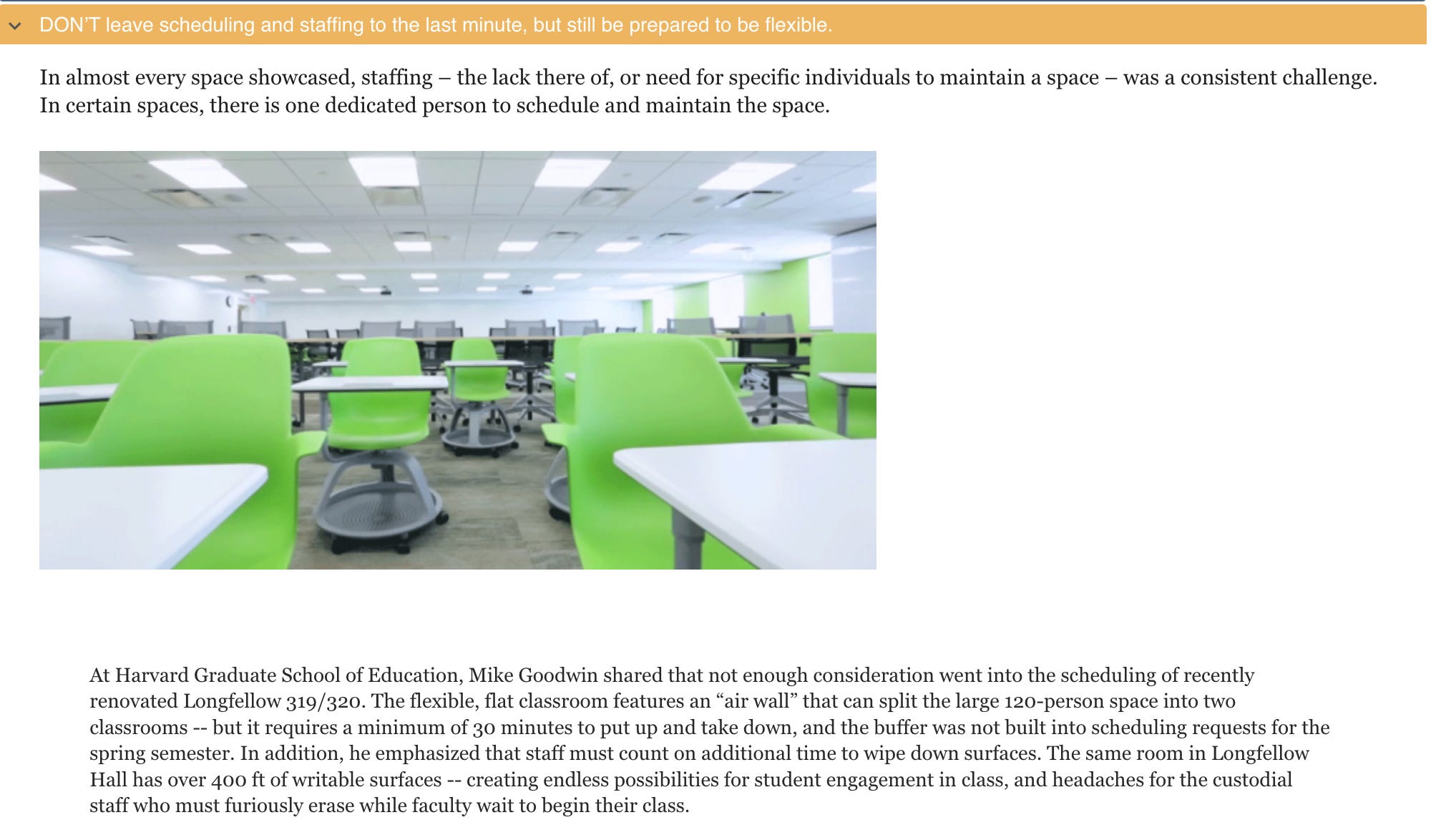
Original link to HILT Site: https://hilt.harvard.edu/teaching-learning-resources/learning-spaces-week-at-harvard/
But it was done. The boards were there. And maybe that’s the heart of it: it’s not about the walls. It’s about what the story of those walls represents.
How Learning Spaces Reflect Institutional Priorities
This story mirrors what I’ve seen again and again in education, especially in EdTech: Well-meaning decisions made in the name of efficiency that quietly undermine pedagogy.
It always starts with a real problem. A practical fix. A good intention. But the implementation often leaves behind something essential. And once the change is made, we’re told to make do. “The tech’s already there. Just work with it.”
Sound familiar?
The counter-argument is familiar too: all classes deserve equal treatment, and we must respect scheduling constraints. More efficiency means more students, more access, more learning, more time, more content.
But, well No. We don’t
We need better learning, better time spent, better content: More space for pedagogy to breathe.
Human-Centered Design but Who-man?
Two years have passed since those boards were installed, and I still hear debates about human-centered design (HCD). But the version of HCD we practice often only includes a narrow group of stakeholders: faculty, staff, administration. The actual humans the students are often left out.
Designing a classroom without instructors input is like designing a playground without talking to children. Even when instructors are consulted, they’re often the most vocal or visible those in student government or formal leadership roles
The surface-level explanation for the whiteboard change was aesthetic and operational. But beneath it, I see a more troubling trend: the growing belief that education is a service to be consumed. I’ve heard it many times: “I pay, so I deserve this.” Learning becomes a transaction. Instructors become content deliverers. Students become clients. And slowly, the classroom stops being a space for wonder, play, or ownership.
The Cost of Treating Education as a Service
I’ve long resisted this mindset. Because when we reduce education to service delivery, we strip away its heart. The unpredictable, co-constructed, joyful mess of learning becomes sterile. Safe. Efficient.
But not alive.
A Small Ritual That Made a Big Difference
One of the simplest, most beautiful practices I’ve adopted? At the end of class, every student grabs a wipe. One per person. In thirty seconds, all the boards are sparkling clean. It’s efficient, sure but more than that, it’s communal. I have never even asked my adult-graduate-level students to do it, not even once. It just happened. And over time, it’s become a quiet ritual that says: This is our space. You belong here. You help take care of it.
That’s what dignified contribution looks like. That’s what real participation feels like in a learning space.
What Does This Have to Do with EdTech?
Everything.
Because too many EdTech products are designed in the same spirit that painted over the white walls. They prioritize ready-launch product over messy and contributive intimacy. Efficiency over pedagogy. Control over co-creation.
Whenever an EdTech founder shows me their latest prototype, instead of asking what it teaches and talking about how personalized or adaptive the design is. I ask:
Where do students get to choose? How do they get to choose?
How are they going to make mistakes on this?
Can they move the metaphorical chairs? Touch the digital walls? Leave a mark?
Because that’s where ownership lives.
The real tragedy of the white walls wasn’t the green paint, or the white boards. It’s that their pedagogical potential was never fully seen: Instead of, “Here’s a room we built for you,” maybe it’s simply, “We’re still figuring it out, want to help?”
When students are invited to contribute, even in small ways, the classroom transforms. It stops being a delivery zone and becomes a shared project. So yes, I’ll keep talking about EdTech design and I’ll keep telling this story. Because these moments remind me what learning spaces are truly made of not just whiteboards and tech, but an active participation in their co-creation of knowledge.
Peace ✌️
N.